
- News
- City News
- mumbai News
- The play that altered Marathi theatre completes 60 years
Trending
This story is from October 16, 2022
The play that altered Marathi theatre completes 60 years
Toh Mee Navhech' (That's Not Me), renowned playwright-humorist P. K. Atre's play, fused love, lies and law into a gripping drama that swept Maharashtra off its feet six decades ago. Connoisseurs gathered at a city auditorium recently to commemorate the play's sixtieth anniversary.
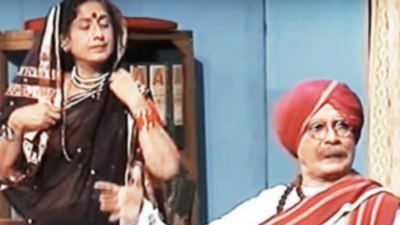
A still from the play
Based on a true story, Toh Mee Navhech chronicled the life and times of Madhav Kazi, self-admittedly a tobacco trader, who would ensnare single women into his web, sweet-talk his way into their lonely hearts, marry them only to fleece them, and dump them before turning to his next target. Needless to add, the Smart Alec soon ended up in prison.
The court case, which rattled the serene 1960s, was extensively reported by the media, including 'Maratha', a Marathi morninger of which Atre was the editor. Referring to his law reporter's copious notes, Atre cut out the legalese and wove an enchanting interplay of human emotions into a fast-paced narrative, peppered with wry humour and sharp dialogues lampooning politicians, bureaucrats and self-styled religious preachers. The real life Madhav Kazi became Lakhoba Lokhande in the play.
Toh Mee Navhech was produced by Natya Niketan, a reputed production house run by theatre stalwart MG Rangnekar. As was his wont, Rangnekar ignored top-rung actors of the time and instead groomed Prabhakar Panshikar - then a 'Natya Niketan' greenhorn in search of a big break - as Lakhoba Lokhande, the protagonist.
Toh Mee Navhech premiered in October 1962 at a theatre festival in Delhi. However, it was a little while before it became a hit. "There would be serpentine queues for tickets. The number of connoisseurs who saw the play again and again is legion," said Daji Shastri Panshikar, Prabhakar's brother and Sanskrit scholar.
Describing Atre's runaway hit as a "landmark, original play", noted critic Arun Naik said, "Toh Mee Navhech was not an adaptation. It was firmly rooted in our soil. Atre and Rangnekar teamed up to explore the theme in a nuanced manner."
Noted theatre person Pratima Kulkarni said the play is laced with social content as Atre lambasts the middle class for its cowardice, dishonesty and utter lack of understanding for young working women eager to tie the knot.
Toh Mee Navhech had its own share of problems, though. Atre fought with Rangnekar over copyright issue. Moreover, Atre claimed the entire credit for the play's success. "While I have cooked the delicious dish, Rangnekar is there only to serve it," he remarked caustically, it is said.
"What is important is the fact that Rangnekar used the 'revolving stage' technique, to keep intact the play's back-and-forth momentum.
More fights and a legal case later Atre affirmed his right over the play and handed it over to Panshikar, who by then had himself turned producer.
For the next four decades, Panshikar toured across Maharashtra, staging the Kazi story in far-flung villages and sleepy tehsils, bustling towns and city squares-sometimes even in a makeshift tent, earning the status of an icon.
End of Article
FOLLOW US ON SOCIAL MEDIA
Visual Stories









Photostories

Hot Picks
TOP TRENDING
Explore Every Corner
Across The Globe
What is Waqf Amendment BillRishabh and Sanjiv Goenka ChatNBA Offseason RumorsMinecraft Craftmine Update GuideStephen CurryWaqf BillRishabh PantWhere to Watch IPLStephen Curry WifeSchedule 1Jill BidenNBA RecordIPL Match TodayDigvesh SinghVal KilmerDwyane WadeMichael WilbonSoros Funded Desi CompanySiddhivinayak Annual RevenueIPL Highest Inning ScoreKunal Kamra CaseBrady TkachukSusan CrawfordApril Bank HolidayIPL Live Score 2025Purple Cap in IPLAll Schedule 1 SuppliersIPL Orange CapIPL Points TableIPL Schedule 2025
Hot on the Web
Bangalore Bevarage RaidMagnesium Deficiency SymptomsKamal HasanShah Rukh KhanSikandar Box Office CollectionSikandar Movie ReviewPrince Yakub Habeebuddin TucyBobby DeolCelebrity MasterchefSikandar Movie ShowsTejasswi PrakashVeera Dheera Sooran 2 Movie ReviewL2 Empuraan ReviewGhibli Style ImagesKitchen Remedies For HairPush Ups BenefitsChia Seeds For HairDates BenefitsVeera Dheera Sooran ReviewUnique MammalsSelenium Rich FoodsHaldi Vs KesarUs VisaNavratri ColoursBrain ExercisesSikandar First ReviewKunal KamraNavratri ColoursUK Immigration PoliciesMoringa Drumstick Potato Curry Recipe
Trending Topics
Satya NadellaAIBE 19 ExamSam AltmanPannun PlotRRB Technician Grade 3 DV Admit cardMary Kate CornettCory BookerChagos IslandPat McAfeeNIOS Admit CardGabriel OlanrewajuLiberation DayLSG IPL 2025 SquadPBKS IPL 2025 SquadNoida ExpresswayGujarat Firecracker Factory FireDevendra FadnavisYogi AdityanathLithuania Army SoldiersNYT ConnectionsNidhi TewariGhibli Style ImageDennis RodmanRahul GandhiWordle TodayElon MuskChatGpt OutagePublic Holidays AprilBank Holidays AprilBobby Witt Jr. Net Worth
Popular Categories
HeadlinesSports NewsBusiness NewsIndia NewsWorld NewsBollywood NewsHealth+ TipsIndian TV ShowsTechnologyTravelEtimesHealth & FitnessWWENFLICC Champions TrophyAstrologyWeather TodayIPLHow to watch IPL 2025How to watch IPL in CanadaHow to watch IPL in USAIPL TeamsStock Market HolidaysNSE HolidaysBSE HolidaysMCX HolidaysTechnology NewsInternational SportsPublic HolidaysBank Holidays
Latest News
Sikkim CM holds meeting with Bollywood film-maker Anurag Basu, actors Kartik and SreeleelaIELTS vs. TOEFL: What’s the difference and which should you choose?US CDC report reveals the shocking cause of viral foodborne outbreaks (it is a warning for those who eat outside or rely on takeaways)CSK squad, IPL 2025: Chennai Super Kings squad with list of players retained and bought at IPL 2025 auctionJames Gunn predicts ‘Superman’ will bring a big boost to the box officeTrailer of Jackie Chan's Karate Kid: Legends promises action-packed entertainerJr NTR opens up about 'Devara 2': "The first part is only half of a bigger story"The Most Luckiest Zodiac Signs in April 2025MPPSC Food Safety Officer Recruitment 2025: Edit window opens, make corrections in application till April 29Pranav Mohanlal plays young Stephen in ‘L2: Empuraan’; Prithviraj revealsMy mother seems to be after my life and I feel my parents are ashamed of meSreelekshmi starrer, 'Teacheramma' set for premiere; showcases the life of a successful teacher but a failed motherAIIMS INI CET July 2025 exam unique code generation postponed, new date announced: Check official notice and key details hereHow did Val Kilmer die? Daughter reveals ‘Top Gun’ and ‘Batman Forever’ actor’s cause of deathDisha Salian death case: Bombay High Court to hear petition filed by father Satish Salian todayHow to play Minecraft April Fools 2025 Craftmine updateAP shows remarkable turn around in GST collections: State chief commissioner of taxes, Babu AhmedMumbai Cricket Association to add two new teams in 3rd edition of T20 Mumbai League
Copyright © 2025 Bennett, Coleman & Co. Ltd. All rights reserved. For reprint rights: Times Syndication Service